Infrared Light: Exploring The Biology of Light, Mitochondria, & Healthspan
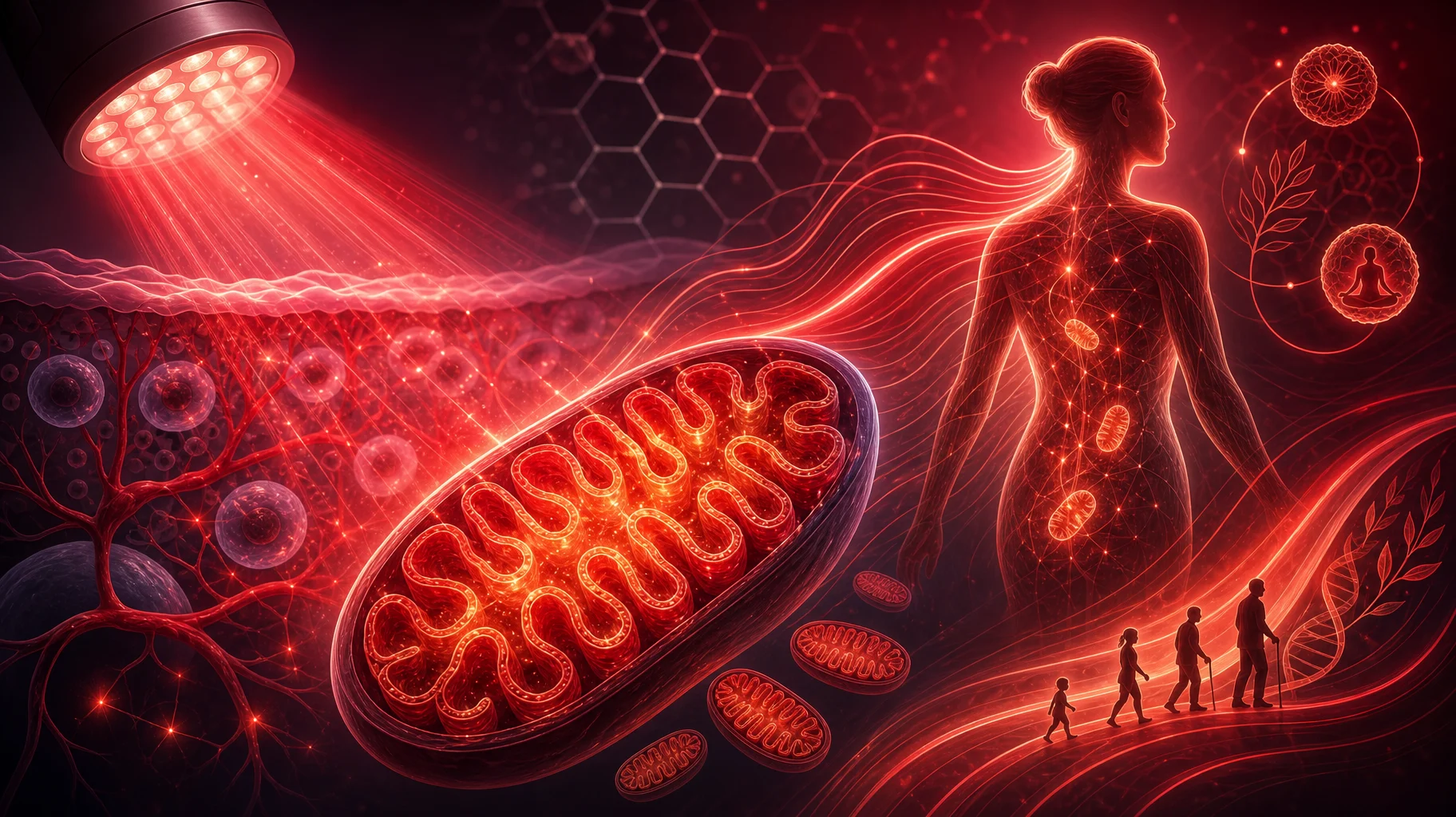
Light is fundamental to health, serving as an environmental signal that interacts with biological systems throughout the body. Its effects are remarkably dynamic, with different wavelengths influencing cellular signaling, mitochondrial function, vascular activity, tissue responses, and thermal regulation. Sunlight contains a broad spectrum of wavelengths, extending beyond the visible light that reaches the eye. Among these are red and infrared wavelengths, which interact with the body in distinct ways. As research continues to explore these wavelengths, infrared light has emerged as an area of interest for understanding how different forms of light influence physiology and healthspan.
The biological effects of light depend in part on wavelength, which shapes how energy interacts with tissue. Red and infrared wavelengths can interact with cellular components, water, blood vessels, and tissue, producing different biological signals depending on the wavelength, intensity, exposure time, and tissue involved. This makes it important to consider infrared light not as one uniform intervention, but as a spectrum with distinct physical and biological properties.
From Sunlight to Cellular Biology
Sunlight provides a useful starting point for understanding the relationship between light and biology. Longer wavelengths within the red and infrared portions of the spectrum can interact with biological tissue in ways that differ from shorter visible wavelengths. Research has increasingly examined how these wavelengths may influence cellular metabolism, mitochondrial activity, vascular signaling, tissue repair, and thermal regulation (1).
At the cellular level, mitochondria are particularly relevant. These organelles integrate signals related to oxygen availability, nutrients, redox balance, and energy demand to support cellular function. Because mitochondria respond to environmental and metabolic cues, they have become a focus of research into photobiomodulation and other light-based approaches.
The biological response to light is not determined by wavelength alone. Irradiance, dose, exposure duration, tissue composition, distance from the light source, and the characteristics of the tissue and delivery method can all influence how much energy reaches a target tissue and the resulting response (2).
One Spectrum, Different Biological Signals
Near-, mid-, and far-infrared wavelengths occupy different portions of the electromagnetic spectrum and interact with biological tissue in different ways. A simplified framework helps illustrate these distinctions:
- Near-infrared: cellular and mitochondrial signaling, with research involving tissue repair, vascular function, and neurological applications
- Mid-infrared: stronger interaction with water and tissue temperature, with potential effects on circulation, soft tissue, and musculoskeletal function
- Far-infrared: radiant heating and thermoregulation, including sweating and cardiovascular responses during sufficiently intense whole-body exposure
This does not mean that each wavelength has only one biological effect. There is considerable overlap, and the response depends on wavelength, dose, delivery method, tissue characteristics, and the individual receiving the exposure.
Together, these differences illustrate why wavelength matters. Near-, mid-, and far-infrared light interact with tissue through different predominant mechanisms, while dose, delivery, and individual physiology shape the resulting response.
Red & Near-Infrared: Light, Mitochondria & Cellular Signaling
Red and near-infrared wavelengths are among the most extensively studied regions of the spectrum in photobiomodulation. These wavelengths can interact with cellular chromophores, including those associated with mitochondrial function. Cytochrome c oxidase has received particular attention as a potential photoacceptor, with downstream effects involving mitochondrial signaling, cellular energy metabolism, nitric oxide biology, and redox signaling (3-4).
A 2025 evidence-based consensus on photobiomodulation (PBM) identifies red and near-infrared light as the primary wavelengths used in PBM, highlighting the significance of wavelength, energy density, light source, and treatment duration when considering clinical application (5). Research continues to expand our understanding of these effects. In cultured human keratinocytes, red light irradiation stimulated mitochondrial fatty acid oxidation through an AMPK-dependent mechanism, suggesting that light can influence cellular energy metabolism beyond ATP production (6). Other research has reported changes in mitochondrial activity and membrane potential following red or near-infrared exposure (7-8).
Near-infrared light has also been studied in relation to vascular signaling. Experimental work suggests that red light may stimulate vasodilation through extracellular vesicle trafficking, providing another mechanism through which light exposure influences tissue physiology (9).
The interaction between near-infrared light and tissue also appears to be relevant to wound healing and neurological research. Earlier work identified mitochondrial signaling as one mechanism associated with accelerated wound and retinal healing following near-infrared light exposure (3). More recent research has explored transcranial photobiomodulation and its effects on neural function, while clinical applications for neurological conditions remain an emerging area of research (10-11).
How much near-infrared light reaches underlying tissue depends on wavelength, tissue absorption and scattering, skin characteristics, irradiance, and delivery method. These variables help determine whether and to what extent tissues are exposed to a biologically meaningful dose (2). A randomized, placebo-controlled study also examined morning near-infrared exposure in healthy individuals with mild sleep-related complaints. At the highest dose studied, improvements in several measures of well-being and health were observed during winter, although no significant effects on sleep or circadian rhythms were found, underscoring the importance of dose, timing, season, and study population when interpreting these findings (12).
Collectively, research on red and near-infrared light has focused particularly on mitochondrial and cellular signaling, with growing investigation into vascular function, tissue repair, and neurological applications.
Mid-Infrared: Water, Tissue Temperature & Circulation
As wavelength increases into the mid-infrared range, the interaction between light and water becomes more pronounced. Water absorbs more strongly at many mid-infrared wavelengths, meaning that the energy can be converted into localized tissue heating and associated physiological response.
This creates a different biological emphasis from the cellular signaling emphasized in photobiomodulation with red and near-infrared light. Mid-infrared exposure may influence tissue temperature, local blood flow, and soft tissue properties, making it particularly relevant to research involving musculoskeletal discomfort, stiffness, and mobility. These thermal effects may also make mid-infrared exposure relevant in preparing tissue for movement and mobility work.
Mid-infrared wavelengths are also being investigated for effects that extend beyond thermal responses. Experimental studies have reported nonthermal effects on neuronal signaling and behavior, while more recent work has examined tissue-specific transmission and potential effects on axonal signal conduction (13-14). These findings are intriguing but remain an emerging area of research, with the 2026 study conducted using mouse tissues and neural preparations rather than human clinical subjects.
Far-Infrared: Radiant Heating & Thermal Regulation
Far-infrared wavelengths interact strongly with water and are generally absorbed near the tissue surface. Rather than relying primarily on photons reaching deep cellular targets, far-infrared exposure can generate radiant heat and stimulate thermoregulatory responses.
This distinction is especially important when considering infrared saunas and other whole-body applications. Under sufficiently intense exposure, far-infrared radiation can increase tissue temperature and create a broader thermal load involving sweating and cardiovascular responses.
Recent research illustrates the importance of exposure conditions. A 2026 study found that a 45-minute far-infrared sauna exposure at 65°C increased rectal temperature by approximately 1.4°C and produced cardiovascular and sweating responses consistent with substantial thermal stress (15).
In contrast, another study found that a single 45-minute far-infrared sauna session increased muscle temperature at several measured depths without significantly changing intestinal temperature. The greatest increases occurred closer to the skin, with heating becoming negligible beyond approximately 3.8 cm in the study population (16).
These findings suggest that far-infrared exposure is best understood in the context of thermal physiology rather than simply as “deep” infrared penetration. The physiological response depends on factors including temperature, exposure duration, humidity, individual heat tolerance, and the characteristics of the infrared source.
Research is also exploring potential applications of infrared and related light therapies in metabolic health, although clinical evidence remains heterogeneous and additional research is needed to establish appropriate applications and protocols (17).
Research involving far-infrared-emitting garments has similarly explored thermoregulation, hemodynamic responses, performance, and recovery, but a systematic review concluded that the available evidence was limited and inconclusive, reinforcing the importance of distinguishing promising mechanisms from established clinical effects (18).
Bioindividuality & Healthspan
The same exposure to near, mid, or far-infrared light may not produce the same response in every individual. Skin pigmentation, age, adiposity, tissue composition, hydration, metabolic state, inflammatory burden, and mitochondrial function can all influence how light or heat interacts with tissue and how the body responds.
Dose is another important consideration. Irradiance, distance, exposure duration, frequency, and the characteristics of the device all contribute to the biological response. For thermal applications, hydration, electrolyte status, cardiovascular health, and heat tolerance may be particularly relevant. These factors underscore the importance of individualized exposure parameters when using higher-intensity or whole-body thermal applications.
This variability reflects a broader principle of biochemical individuality: biological responses are shaped by individual characteristics and physiological context. Infrared light may provide one environmental input, but its potential effects are best considered within the broader context of nutrition, movement, sleep, circadian rhythm, stress physiology, and other determinants of health. This context is central to healthspan, where the focus extends beyond a single response to supporting resilience and function over time.
Light, Mitochondria & Health
Mitochondria provide an important connection between these different layers of physiology. They are central to cellular energy production, but their role extends into redox signaling, metabolism, inflammation, and cellular stress responses. Research is also increasingly examining how mitochondrial function relates to mental health, with mitochondrial dysfunction implicated in mood disorders (19).
Supporting mitochondrial function extends beyond any single intervention. Adequate nutrition provides the substrates and micronutrients required for energy metabolism; regular movement influences mitochondrial capacity; sleep and circadian regularity help coordinate metabolic processes; and stress and recovery shape energy demands throughout the body.
These factors also influence the physiological context in which environmental signals such as light interact with the body. From this perspective, it is beneficial to consider light within the broader landscape of whole-person health. Mitochondrial function provides a connection between these domains, linking cellular energy metabolism with processes relevant to physical health, brain function, and healthspan.
As research continues to clarify how different wavelengths interact with mitochondria, tissue, water, circulation, and thermal physiology, infrared light remains an emerging area of interest in healthspan research.
Join Jeffrey Bland, PhD, Connie Zack, and Dr. Will Cole on October 27 from 5–7 pm Pacific Time for the webinar, Infrared Insights: Unlocking the Science of Light Therapy for Healthspan and Lifespan. Together, they will explore the science behind infrared wavelengths and their applications in health and longevity.
The webinar will examine how near-, mid-, and far-infrared light interact with biology—and how their distinct mechanisms may inform use of such therapies within a broader approach to health.
References:
- Jeffery G, Fosbury R, Barrett E, Hogg C, Carmona MR, Powner MB. Longer wavelengths in sunlight pass through the human body and have a systemic impact which improves vision. Sci Rep. 2025 Jul 8;15(1):24435. doi: 10.1038/s41598-025-09785-3. PMID: 40628952; PMCID: PMC12238558.
- Henderson TA. Can infrared light really be doing what we claim it is doing? Infrared light penetration principles, practices, and limitations. Front Neurol. 2024 Aug 28;15:1398894. doi: 10.3389/fneur.2024.1398894. PMID: 39263274; PMCID: PMC11388112.
- Eells JT, Wong-Riley MT, VerHoeve J, Henry M, Buchman EV, Kane MP, Gould LJ, Das R, Jett M, Hodgson BD, Margolis D, Whelan HT. Mitochondrial signal transduction in accelerated wound and retinal healing by near-infrared light therapy. Mitochondrion. 2004 Sep;4(5-6):559-67. doi: 10.1016/j.mito.2004.07.033. PMID: 16120414.
- Nguyen LM, Malamo AG, Larkin-Kaiser KA, Borsa PA, Adhihetty PJ. Effect of near-infrared light exposure on mitochondrial signaling in C2C12 muscle cells. Mitochondrion. 2014 Jan;14(1):42-8. doi: 10.1016/j.mito.2013.11.001. Epub 2013 Nov 15. PMID: 24246911.
- Maghfour J, Mineroff J, Ozog DM, Jagdeo J, Lim HW, Kohli I, Anderson R, Kelly KM, Mamalis A, Munavalli G, Cleber F, Siegel D, Geneva I, Weiss R, Morita A, Juanita A, Goldman MP, Arany PR, Sliney D, Ibrahimi OA, Chopp M, Esmat S, Tuner J. Evidence-based consensus on the clinical application of photobiomodulation. J Am Acad Dermatol. 2025 Aug;93(2):429-443. doi: 10.1016/j.jaad.2025.04.031. Epub 2025 Apr 17. PMID: 40253006.
- Herrera MA, Caldeira da Silva CC, Von Dentz M, Baptista MS, Kowaltowski AJ. Mitochondrial fatty acid oxidation is stimulated by red light irradiation. FEBS Lett. 2026 Jan;600(1):20-38. doi: 10.1002/1873-3468.70195. Epub 2025 Oct 18. PMID: 41108719; PMCID: PMC12793707.
- Umino Y, Denda M. Effect of red light on epidermal proliferation and mitochondrial activity. Skin Res Technol. 2023 Sep;29(9):e13447. doi: 10.1111/srt.13447. PMID: 37753678; PMCID: PMC10462800.
- Rono C, Oliver TR. Near infrared light exposure is associated with increased mitochondrial membrane potential in retinal pigmented epithelial cells. Photochem Photobiol Sci. 2020 Oct 1;19(10):1455-1459. doi: 10.1039/d0pp00168f. Epub 2020 Oct 1. PMID: 33000839.
- Weihrauch D, Keszler A, Lindemer B, Krolikowski J, Lohr NL. Red light stimulates vasodilation through extracellular vesicle trafficking. J Photochem Photobiol 2021 Jul;220:112212. doi: 10.1016/j.jphotobiol.2021.112212. Epub 2021 May 12. PMID: 34049180; PMCID: PMC8240139.
- Su M, Nizamutdinov D, Liu H, Huang JH. Recent Mechanisms of Neurodegeneration and Photobiomodulation in the Context of Alzheimer’s Disease. Int J Mol Sci. 2023 May 25;24(11):9272. doi: 10.3390/ijms24119272. PMID: 37298224; PMCID: PMC10253105.
- De Ridder D, Hamblin MR, Vanneste S. Transcranial Photobiomodulation for Neuromodulation of Brain Disorders: A Perspective. Neuromodulation. 2026 Feb 5:S1094-7159(25)01203-6. doi: 10.1016/j.neurom.2025.12.006. Epub ahead of print. PMID: 41642156.
- Giménez MC, Luxwolda M, Van Stipriaan EG, Bollen PP, Hoekman RL, Koopmans MA, Arany PR, Krames MR, Berends AC, Hut RA, Gordijn MCM. Effects of Near-Infrared Light on Well-Being and Health in Human Subjects with Mild Sleep-Related Complaints: A Double-Blind, Randomized, Placebo-Controlled Study. Biology (Basel). 2022 Dec 29;12(1):60. doi: 10.3390/biology12010060. PMID: 36671752; PMCID: PMC9855677.
- Liu X, Qiao Z, Chai Y, Zhu Z, Wu K, Ji W, Li D, Xiao Y, Mao L, Chang C, Wen Q, Song B, Shu Y. Nonthermal and reversible control of neuronal signaling and behavior by midinfrared stimulation. Proc Natl Acad Sci U S A. 2021 Mar 9;118(10):e2015685118. doi: 10.1073/pnas.2015685118. PMID: 33649213; PMCID: PMC7958416.
- Liu X, Wang Z, Qiao Z, Xiao Y, Guo H, Shu Y. Mid-Infrared Light Exhibits Tissue-Specific Transmittance and Modulates Neural Signal Conduction Along Axons. Neurosci Bull. 2026 Jul;42(7):1459-1472. doi: 10.1007/s12264-025-01542-w. Epub 2025 Nov 10. PMID: 41214417; PMCID: PMC13388595.
- Jenkins EJ, Killick JA, Grimm SR, Davies SR, Benson JA, Tremblay JC, Stembridge M. Far-infrared sauna exposure at 65°C elevates core temperature. Exp Physiol. 2026 Jul 31:10.1113/EP094028. doi: 10.1113/EP094028. Epub ahead of print. PMID: 42533687; PMCID: PMC13424908.
- Reed EL, Uzoekwe CC, Atencio JK, Minson CT, Halliwill JR. Muscle temperature increases during a single far infrared sauna session without changes in intestinal temperature. J Appl Physiol (1985). 2025 Jun 1;138(6):1628-1637. doi: 10.1152/japplphysiol.00067.2025. Epub 2025 May 7. Erratum in: J Appl Physiol (1985). 2025 Nov 1;139(5):1344. doi: 10.1152/japplphysiol.00067.2025_COR. PMID: 40331900; PMCID: PMC13104632.
- Nowacka A, Śniegocki M, Smuczyński W, Ziółkowska E. Therapeutic Potential of Infrared and Related Light Therapies in Metabolic Diseases. Int J Mol Sci. 2025 May 27;26(11):5134. doi: 10.3390/ijms26115134. PMID: 40507946; PMCID: PMC12154360.
- Bontemps B, Gruet M, Vercruyssen F, Louis J. Utilisation of far infrared-emitting garments for optimising performance and recovery in sport: Real potential or new fad? A systematic review. PLoS One. 2021 May 6;16(5):e0251282. doi: 10.1371/journal.pone.0251282. PMID: 33956901; PMCID: PMC8101933.
- Giménez-Palomo A, Dodd S, Anmella G, Carvalho AF, Scaini G, Quevedo J, Pacchiarotti I, Vieta E, Berk M. The Role of Mitochondria in Mood Disorders: From Physiology to Pathophysiology and to Treatment. Front Psychiatry. 2021 Jul 6;12:546801. doi: 10.3389/fpsyt.2021.546801. PMID: 34295268; PMCID: PMC8291901.