
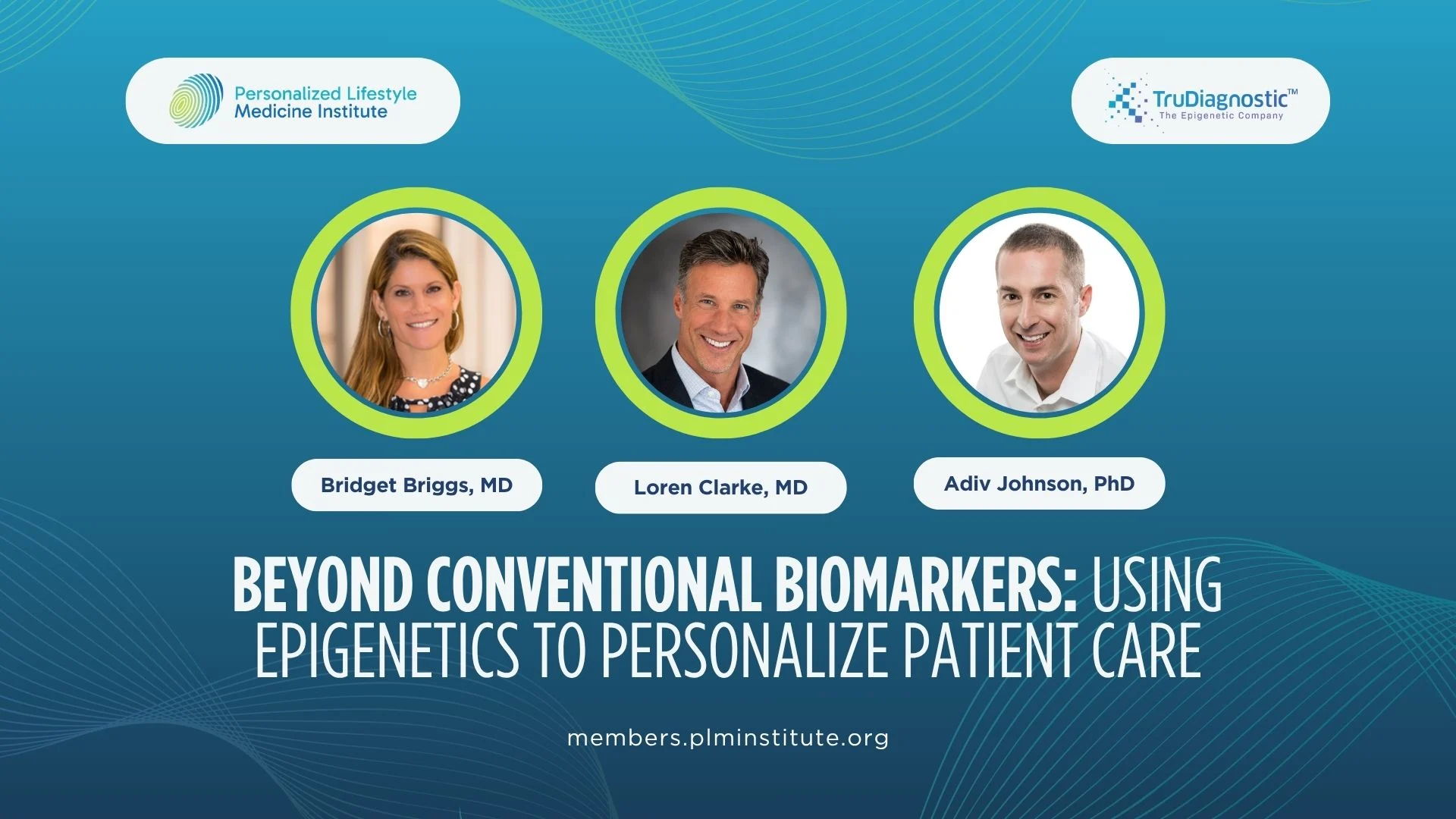
Beyond Conventional Biomarkers: Using Epigenetics to Personalize Patient Care
Course Description
Epigenetics is providing clinicians with a new lens through which to understand biological aging, lifestyle and environmental exposures, inflammation, immune function, and changes in health trajectory over time. While conventional and functional biomarkers remain essential to patient assessment, epigenetic testing can provide an additional layer of biological information that may confirm existing findings, reveal unexpected patterns, and help clinicians identify areas that warrant deeper investigation.
This webinar begins with a practical introduction to epigenetics and its evolving role in clinical practice. Dr. Bridget Briggs will share how incorporating epigenetic testing has impacted her clinic, including how these insights have influenced patient assessment, clinical decision-making, personalization of care, and patient engagement.
The program will then be guided by Loren Clarke, MD & Adiv Johnson, PhD to explore the science and clinical utility of DNA methylation testing, including biological age and pace-of-aging measures, methylation-derived biomarkers, inflammatory and exposure-related signatures, immune-cell composition, and longitudinal assessment. Through real-world clinical cases, attendees will examine how epigenetic findings can complement conventional biomarkers, provide a different time horizon into patient health, and help clinicians investigate discordant or unexpected findings.
By combining clinical experience, scientific foundations, and case-based learning, this session will provide clinicians with a practical framework for incorporating epigenetic information as an adjunct to conventional and functional assessment and using these insights to support more personalized, evidence-informed patient care.
Learning Objectives
- Describe the foundational principles of epigenetics and DNA methylation and their relevance to personalized clinical care.
- Examine how biological age, pace-of-aging measures, and other methylation-derived biomarkers can provide information distinct from conventional laboratory assessment.
- Explore how epigenetic testing may provide insight into biological aging, inflammation, lifestyle and environmental exposures, immune-cell patterns, and health trajectory.
- Evaluate real-world clinical cases in which epigenetic findings confirm, challenge, or add context to conventional and functional biomarkers.
- Discuss strategies for interpreting concordant and discordant findings, including when additional assessment or confirmation may be warranted.
- Apply practical principles for integrating epigenetic testing into clinical practice, including longitudinal assessment and the use of trends to inform personalized, evidence-informed care.
Agenda & Speakers
- Dr. Bridget Briggs: introduction to epigenetics, its relevance to personalized lifestyle medicine, and the impact incorporating epigenetic testing has had on her clinic and approach to patient care (30 min)
- Loren Clarke, MD & Adiv Johnson, PhD: beyond conventional biomarkers and translating epigenetic insights into clinical practice—including DNA methylation, biological age and pace of aging, what epigenetic testing adds to the clinical picture, longitudinal assessment, inflammatory and exposure signatures, immune-cell composition, interpretation of unexpected findings, real-world clinical case applications, and practical clinical takeaways (60 min)
- Panel Discussion led by Dr. Bridget Briggs: 30-minute conversation with all speakers focused on clinical application, interpretation, and practical integration of epigenetic insights into personalized patient care (30 min)
Speakers
-
 Adiv Johnson, PhD
Adiv Johnson, PhD, has dedicated nearly 20 years to the field of aging research, contributing more than 50 peer-reviewed publications relevant to aging, age-related disease, and regenerative medicine. After earning his PhD in Physiological Sciences from the University of Arizona, he completed a postdoctoral fellowship in the Department of Ophthalmology at the Mayo Clinic. Adiv’s expertise in aging biomarkers, paired with a longstanding passion for improving longevity, led him to the founding team of Tally Health (an Infinite Epigenetics company), where he currently serves as the Chief Scientific Officer.
-
 Bridget Briggs, MD
Dr. Bridget Briggs, MD has been empowering patients to live inspired healthy lives for over 20 years. Her integrative approach and profound knowledge of genetics, epigenetics, nutrigenomics and biochemistry has paved the way to her advanced methods in precise, personalized, preventative medicine. Dr. Briggs is a board certified Family Medicine Physician who is at the forefront of the emerging science of genetics and how a patient’s DNA can be altered to prevent disease or treat current ailments with a personalized treatment plan.She specializes in functional medicine, bio-identical hormones, lipidology, women’s health, pediatrics, geriatrics, detoxification, nutritional and dietary support.Her expertise in genetic testing and interpretation allows her to develop a precise treatment approach leading to improvement in all areas of disease ranging from chronic migraines, fatigue, anxiety, depression, autism, GERD, IBS, SIBO issues among others.
-
 Loren Clarke, MD
I am a board-certified pathologist and physician-executive with 25 years of experience advancing molecular diagnostics from initial concept through clinical adoption. In senior industry leadership roles at Myriad Genetics, DermTech, and
now TruDiagnostic, I have led clinical strategy, evidence generation, and medical affairs for multiple biomarker-driven clinical tests, demonstrating their analytical and clinical performance through rigorous study designs, peer-reviewed publications, and clear clinical value narratives for clinicians, payers, patients, and regulators. My academic background at Penn State Hershey Medical Center included leadership roles in molecular pathology and close collaboration with
multidisciplinary clinical and laboratory teams, grounding my work in the practical aspects of real-world diagnostic decision-making. I bring a patient-centered, outcomes-driven approach to diagnostics, with extensive experience guiding
cross-functional teams across R&D, clinical development, regulatory approval, and commercial execution.