
From Damage to Dysfunction: How a Compromised Stem Cell Repair System Drives Chronic Inflammation & Degenerative Disease
Chronic disease does not arise from damage alone. Rather, it reflects a progressive disruption in the body’s ability to repair, regenerate, and maintain tissue integrity. At the center of this process is a significant, coordinated, though often underrecognized, system: the endogenous stem cell repair network.
Stem cells (undifferentiated cells capable of self-renewal and differentiation) serve as the biological foundation for tissue maintenance and regeneration. Tissue-specific populations are distributed throughout the body, including in the brain, muscle, liver, pancreas, and intestine, where they function as a reserve pool for repair and adaptation (1). Their activity is regulated by specialized microenvironments, or “niches,” which integrate metabolic, immune, circadian, and biochemical signals to sustain regenerative capacity.
This perspective shifts the clinical lens. Rather than defining health solely by the absence of disease, a more informative question emerges: how effectively can the body repair and restore itself over time?
Within this context, the progressive compromise of the endogenous stem cell system becomes central. As this network loses efficiency (through changes in signaling, cellular function, or the surrounding niche), the body’s ability to maintain tissue integrity and resolve injury becomes increasingly constrained. Over time, this impaired regenerative capacity may contribute not only to persistent inflammation but to the progression of degenerative disease across tissues and organ systems.
The Promise & Fragility of Endogenous Repair
Mobilizing the body’s own repair systems has become a central focus in regenerative medicine, highlighting the potential to optimize resident stem cells for tissue regeneration and systemic resilience (2).
Adult tissues maintain populations of stem and progenitor cells that support ongoing turnover. In the central nervous system, endogenous neural stem cells retain the capacity for neurogenesis following injury, though this capacity declines with age, inflammation, and metabolic stress (3). Similarly, skeletal muscle and bone rely on resident stem cells for regeneration, yet their function becomes impaired with aging and metabolic dysfunction (4-5).
Advances in stem cell biology—including mesenchymal stem cells (MSCs), induced pluripotent stem cells, and stem cell-derived exosomes—have further expanded our understanding of regenerative signaling. These systems not only drive tissue repair but also modulate immunity, resolve inflammation, and facilitate intercellular communication (6).
This reinforces a key concept: in chronic disease, regeneration is rarely absent, but constrained, dysregulated, and insufficient to meet tissue demands—contributing to the progressive decline of endogenous repair mechanisms.
How the Endogenous Repair System Becomes Compromised
Across the lifespan, cumulative internal and external stressors alter stem cell behavior and degrade the integrity of the stem cell niche through interconnected mechanisms.
Inflammaging: Chronic Cytokine Signaling – Persistent low-grade inflammation alters stem cell function at a fundamental level. Pro-inflammatory cytokines, such as TNF-α and IL-6, shift stem cell metabolism, increase oxidative stress, and promote premature differentiation.
Over time, this contributes to reduced self-renewal and the accumulation of dysfunctional progenitor cells—a process aligned with stem cell exhaustion as a hallmark of aging (7).
Mitochondrial Dysfunction: Bioenergetic Constraints – Stem cell maintenance is energetically demanding. Mitochondrial dysfunction reduces ATP availability while increasing reactive oxygen species, impairing DNA repair, proteostasis, and controlled proliferation.
This bioenergetic decline also disrupts epigenetic regulation and cellular signaling. Importantly, mitochondrial dysfunction has been linked to impaired neurogenesis and broader alterations in brain bioenergetics associated with psychiatric vulnerability, suggesting a connection between stem cell health, brain function, and mental health outcomes (8).
Epigenetic Drift: Loss of Regenerative Fidelity – Stem cell identity is governed by dynamic epigenetic regulation. With aging and chronic stress, DNA methylation, histone modification, and non-coding RNA signaling become dysregulated.
These shifts suppress regenerative gene expression while amplifying inflammatory pathways, reducing the precision and adaptability of repair processes (9).
Cellular Senescence & Niche Degradation – Senescent cells accumulate over time and adopt a pro-inflammatory phenotype (SASP), secreting cytokines and degrading the extracellular matrix.
This disrupts the stem cell niche, impairing signaling and reducing the ability of even intact stem cells to execute effective repair.
Immune Dysregulation & Hematopoietic Shifts – Aging alters hematopoietic stem cell dynamics, often biasing toward pro-inflammatory immune cell lineages. This contributes to chronic inflammation, reduced immune adaptability, and compromised regenerative signaling.
Environmental Inputs, Microbiome & Barrier Function – Stem cell function is highly responsive to environmental inputs.
Dietary patterns modulate intestinal stem cell proliferation, differentiation, and metabolism (10-11). Microbiome-derived metabolites further influence stem cell signaling pathways, including mTOR-mediated mechanisms that shape long-term tissue health (12).
These effects begin early in life, with maternal microbiome composition influencing offspring stem cell programming and developmental trajectories.
Environmental toxicants, including endocrine-disrupting chemicals, further impede stem cell function through oxidative stress, hormonal disruption, and epigenetic modification (13).
Loss of Adaptive Signaling: Hormesis – Stem cells respond to hormetic stressors, which are low-dose challenges that enhance resilience. Stimuli such as exercise, caloric restriction, phytochemicals, thermal stress (e.g., sauna and cold exposure), and mild oxidative stress activate adaptive pathways that support regeneration (14-15).
These inputs upregulate cellular defense and repair mechanisms, including heat shock proteins, antioxidant systems, mitochondrial biogenesis, and autophagy, helping maintain stem cell function and tissue integrity.
When these inputs are absent, adaptive signaling diminishes, further contributing to regenerative decline.
From Impaired Repair to Chronic Disease
As endogenous repair capacity becomes progressively constrained, the downstream effects are systemic and self-reinforcing. Across tissues, reduced stem cell function shifts the balance from regeneration toward degeneration, contributing to characteristic patterns of dysfunction:
- Musculoskeletal system: diminished regenerative capacity, contributes to sarcopenia, osteoporosis, osteoarthritis, and impaired fracture healing (4-5).
- Brain: reduced neurogenesis alongside heightened neuroinflammatory signaling increases vulnerability to cognitive decline, Alzheimer’s disease, Parkinson’s disease, and mood disorders (3).
- Metabolic tissues: stem cell dysfunction promotes insulin resistance, type 2 diabetes, hepatic steatosis, and fibrosis.
- Immune system: chronic low-grade inflammation coupled with reduced adaptive capacity (immunosenescence).
- Barrier tissues (gut/skin): impaired epithelial renewal and increased permeability contribute to inflammatory bowel disease, psoriasis, eczema, and systemic inflammation (16).
Across these conditions, stem cell dysfunction is increasingly recognized as a shared upstream contributor to chronic and degenerative disease, consistent with models of aging in which stem cell exhaustion drives declining physiological resilience (17, 18).
A Unifying Principle
At a systems level, these changes reflect a shift in biological regulation:
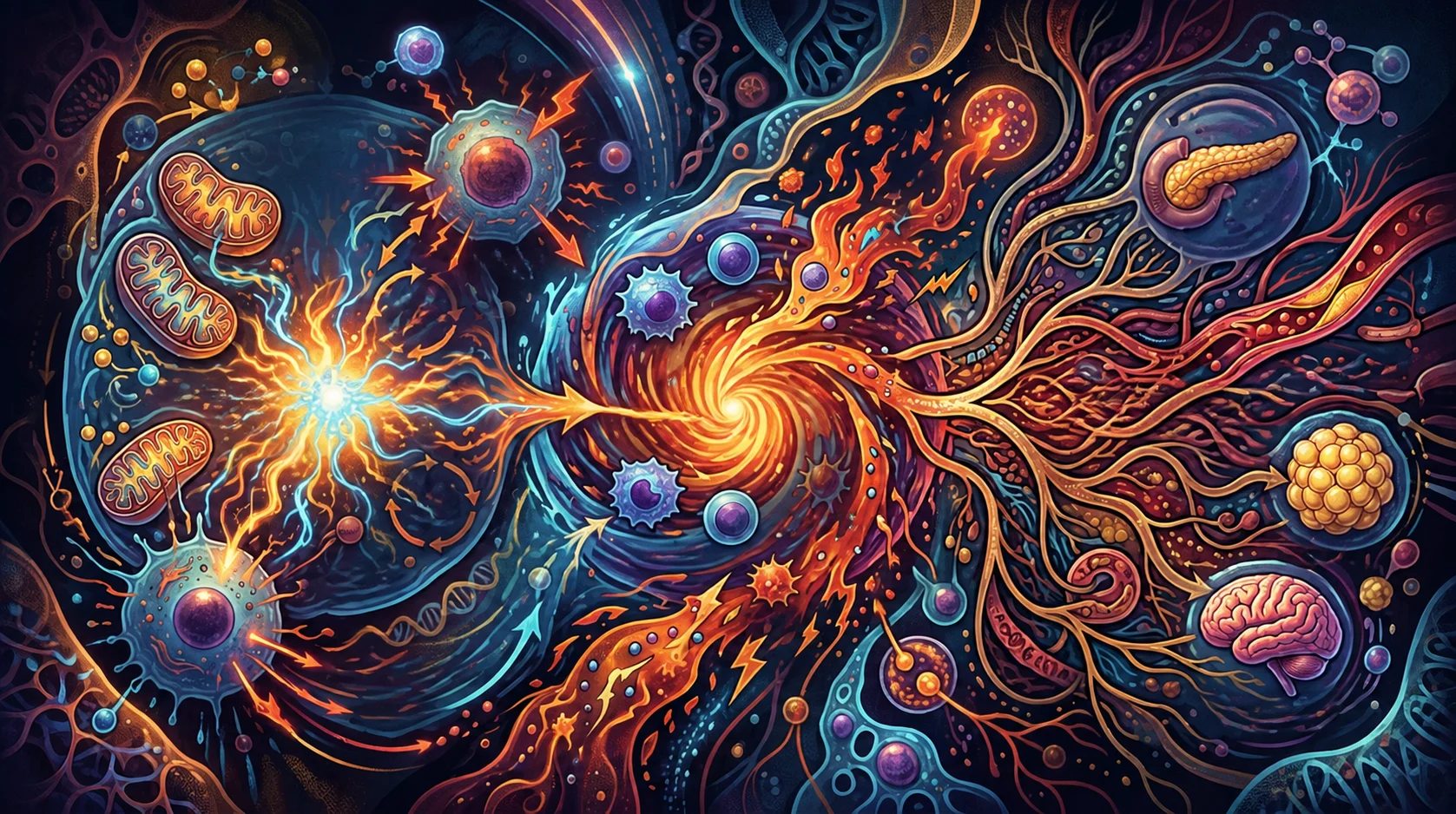
Chronic inflammation, mitochondrial inefficiency, and epigenetic alterations form an interconnected network that progressively reshapes both stem cell behavior and the environments in which these cells function.
Within this context, inflammatory signaling alters differentiation and repair dynamics, bioenergetic constraints limit the capacity for high-fidelity regeneration, and epigenetic changes recalibrate gene expression toward stress adaptation over restoration.
Over time, repair processes may become less precise and more energetically constrained. Instead of fully restoring tissue integrity, the body may increasingly rely on compensatory responses—such as fibrosis, remodeling, or persistent low-grade inflammation.
This reflects a gradual divergence between two processes that are ideally synchronized: ongoing damage exposure and effective repair and renewal.
As this coordination becomes less efficient, physiological resilience narrows, and vulnerability to chronic disease increases.
Effective regeneration also depends on coordinated intercellular communication. Stem cells continuously exchange signals with immune, metabolic, and structural cells through cytokines, growth factors, and extracellular vesicles. Disruption in this signaling network may further impair the timing, precision, and integration of repair processes across tissues.
Restoring Endogenous Repair
Importantly, endogenous repair systems retain meaningful plasticity.
Stem cell function remains highly responsive to internal and external signals—creating a therapeutic opportunity not only to intervene downstream, but to restore the conditions that support coordinated regeneration.
Key regulatory inputs include:
Nutrition: Shapes stem cell metabolism, differentiation, and microbiome-derived signaling—particularly within the intestinal niche (10, 15). Bioactive nutrients, short-chain fatty acids, and amino acid profiles influence stem cell fate and regenerative capacity, in part through microbiome-mediated signaling.
Physical activity: Enhances mitochondrial biogenesis, improves bioenergetic efficiency, and promotes stem cell activation across multiple tissues.
Sleep & circadian alignment: Synchronize repair processes, hormonal signaling, and redox balance, establishing an optimal environment for cellular renewal. Circadian rhythms within stem cell populations may further influence proliferative cycles and timing of interventions (19).
Sunlight exposure: Supports circadian entrainment, mitochondrial signaling, and immune regulation.
Stress modulation: Acts through neuroendocrine and autonomic pathways to influence inflammatory tone, contributing to a more favorable regenerative environment (e.g., meditation, yoga, intensive mind-body therapies). RCT evidence suggests that intensive mind-body interventions may increase peripheral stem cell counts and telomerase activity, indicating a measurable effect on endogenous repair capacity and cellular longevity (20). These effects are likely mediated through coordinated changes in autonomic balance, HPA axis signaling, and inflammatory regulation—pathways that directly influence stem cell behavior and niche function.
These inputs converge on key, interconnected biological pathways:
- Mitochondrial efficiency & ATP availability
- Inflammatory regulation & resolution
- Epigenetic stability & gene expression fidelity
- Adaptive (hormetic) signaling
- Circadian gene expression & rhythmic metabolic regulation
Together, they function as integrated regulatory signals that actively shape the stem cell niche and re-establish the conditions necessary for coordinated, effective tissue repair.
Why This Matters: A Functional Lens
From a functional medicine perspective, chronic disease can be understood as a shift in system-wide regulation, characterized by reduced regenerative efficiency, persistent, unresolved inflammation, and diminished adaptive capacity.
The endogenous stem cell system sits at the intersection of these processes, integrating signals from the environment, metabolism, immune activity, neuroendocrine regulation, and tissue repair.
This perspective reframes clinical strategy, shifting focus toward preserving or restoring regenerative capacity.
A Regenerative Model of Health
Advances in stem cell biology—from endogenous mobilization to exosome signaling and regenerative therapeutics—continue to reshape our understanding of health and disease (6, 17).
At the same time, important challenges remain, including translating mechanistic insights into clinical protocols, understanding tissue-specific niche regulation, and ensuring safety, precision, and long-term efficacy.
Even so, the broader trajectory is clear; health is increasingly defined not simply by the absence of disease, but by the capacity to repair, adapt, and maintain functional integrity over time.
Supporting endogenous repair systems may represent one of the most meaningful strategies for influencing long-term health outcomes—particularly in the context of aging, metabolic dysfunction, and neurocognitive resilience.
Join the Conversation
To further explore these concepts, join our upcoming webinar, Stem Cells: The Cornerstone of Human Health, on April 28th from 5 to 7 pm.
This session will cover:
- The science of endogenous stem cell mobilization (ESCM)
- Mechanisms linking stem cells, inflammation, and aging
- The role of natural compounds and lifestyle factors in supporting regeneration
- Clinical applications in health optimization and integrative care
Featuring insights from leaders in functional and regenerative medicine: Jeffrey Bland, Christian Drapeau, and Mark Atkinson, this discussion offers a comprehensive framework for understanding how supporting the body’s innate regenerative capacity informs and expands modern approaches to health.
References
- Fu X, He Q, Tao Y, Wang M, Wang W, Wang Y, Yu QC, Zhang F, Zhang X, Chen YG, Gao D, Hu P, Hui L, Wang X, Zeng YA. Recent advances in tissue stem cells. Sci China Life Sci. 2021 Dec;64(12):1998-2029. doi: 10.1007/s11427-021-2007-8. Epub 2021 Nov 30. PMID: 34865207.
- Miller FD, Kaplan DR. Mobilizing endogenous stem cells for repair and regeneration: are we there yet? Cell Stem Cell. 2012 Jun 14;10(6):650-652. doi: 10.1016/j.stem.2012.05.004. PMID: 22704501.
- Okano H, Sakaguchi M, Ohki K, Suzuki N, Sawamoto K. Regeneration of the central nervous system using endogenous repair mechanisms. J Neurochem. 2007 Sep;102(5):1459-1465. doi: 10.1111/j.1471-4159.2007.04674.x. PMID: 17697047.
- Chung JD, Porrello ER, Lynch GS. Muscle regeneration and muscle stem cells in metabolic disease. Free Radic Biol Med. 2025 Feb 1;227:52-63. doi: 10.1016/j.freeradbiomed.2024.11.041. Epub 2024 Nov 22. PMID: 39581389.
- Weldon KC, Longaker MT, Ambrosi TH. Harnessing the diversity and potential of endogenous skeletal stem cells for musculoskeletal tissue regeneration. Stem Cells. 2025 Mar 10;43(3):sxaf006. doi: 10.1093/stmcls/sxaf006. PMID: 39945760; PMCID: PMC11892563.
- Galow AM, Agriesti F. Advances in Stem Cell Research-Insights from the Special Issue “Stem Cells in Health and Disease 2.0”. Int J Mol Sci. 2024 Dec 13;25(24):13364. doi: 10.3390/ijms252413364. PMID: 39769129; PMCID: PMC11677540.
- Rando, T. A., Brunet, A., & Goodell, M. A. (2025). Hallmarks of stem cell aging. Cell Stem Cell, 32(7), 1038–1054.
- Nunes, P. I. G., Benjamin, S. R., Brito, R. d. S., de Aguiar, M. R., Neves, L. B., & de Bruin, V. M. S. (2025). Mitochondria, Oxidative Stress, and Psychiatric Disorders: An Integrative Perspective on Brain Bioenergetics. Clinical Bioenergetics, 1(1), 6. https://doi.org/10.3390/clinbioenerg1010006
- Liu B, Wang Y, Chu X, Wang J, Pan T, Xie L, Abankwah JK, Bian Y. Epigenetics in intestinal stem cells: Molecular mechanisms underpinning the guardians of homeostasis in health and aging-related senescence. Pathol Res Pract. 2025 Nov;275:156187. doi: 10.1016/j.prp.2025.156187. Epub 2025 Aug 28. PMID: 40946424.
- Fan H, Wu J, Yang K, Xiong C, Xiong S, Wu X, Fang Z, Zhu J, Huang J. Dietary regulation of intestinal stem cells in health and disease. Int J Food Sci Nutr. 2023 Nov;74(7):730-745. doi: 10.1080/09637486.2023.2262780. Epub 2023 Nov 15. PMID: 37758199.
- Yao C, Gou X, Tian C, Zhou L, Hao R, Wan L, Wang Z, Li M, Tong X. Key regulators of intestinal stem cells: diet, microbiota, and microbial metabolites. J Genet Genomics. 2023 Oct;50(10):735-746. doi: 10.1016/j.jgg.2022.12.002. Epub 2022 Dec 23. PMID: 36566949.
- Dang H, Feng P, Zhang S, Peng L, Xing S, Li Y, Wen X, Zhou L, Goswami S, Xiao M, Barker N, Sansonetti P, Kundu P. Maternal gut microbiota influence stem cell function in offspring. Cell Stem Cell. 2025 Feb 6;32(2):246-262.e8. doi: 10.1016/j.stem.2024.10.003. Epub 2024 Dec 11. PMID: 39667939.
- Muñoz, J. P. (2025). Impact of endocrine-disrupting chemicals on stem cells. Journal of Environmental Sciences, 147, 294–309.
- Calabrese EJ. Hormesis and embryonic stem cells. Chem Biol Interact. 2022 Jan 25;352:109783. doi: 10.1016/j.cbi.2021.109783. Epub 2021 Dec 18. PMID: 34932953.
- Puca F, Fedele M, Rasio D, Battista S. Role of Diet in Stem and Cancer Stem Cells. Int J Mol Sci. 2022 Jul 23;23(15):8108. doi: 10.3390/ijms23158108. PMID: 35897685; PMCID: PMC9330301.
- Zhang, W., Zhang, J., Cui, Y., Zhao, Y., & Lei, X. (2023). Stem cells and exosome applications for cutaneous wound healing: From ground to microgravity environment. Stem Cell Reviews and Reports, 19(1), 1–15. https://doi.org/10.1007/s12015-023-10571-9
- Brockmueller, A., Mahmoudi, N., Movaeni, A. K., et al. (2023). Stem cells and natural agents in the management of neurodegenerative diseases. Neurochemical Research, 48(1), 39–53.
- Zhu Y, Ge J, Huang C, Liu H, Jiang H. Application of mesenchymal stem cell therapy for aging frailty: from mechanisms to therapeutics. Theranostics. 2021 Mar 31;11(12):5675-5685. doi: 10.7150/thno.46436. PMID: 33897874; PMCID: PMC8058725.
- Putthanbut N, Su PAB, Lee JY, Borlongan CV. Circadian rhythms in stem cells and their therapeutic potential. Stem Cell Res Ther. 2025 Feb 23;16(1):85. doi: 10.1186/s13287-025-04178-9. PMID: 39988679; PMCID: PMC11849187.
- Rao KS, Chakraharti SK, Dongare VS, Chetana K, Ramirez CM, Koka PS, Deb KD. Antiaging Effects of an Intensive Mind and Body Therapeutic Program through Enhancement of Telomerase Activity and Adult Stem Cell Counts. J Stem Cells. 2015;10(2):107-25. PMID: 27125139.